TL;DR: ePBS adds an in-protocol, sealed-by-default first-price channel for builder–proposer payments. We expect relays to survive, but the in-protocol channel reshapes what they can offer. We predict that trustless payments in-protocol will ossify a first-price block auction. Whether and how bids are shared publicly post-Glamsterdam is more subtle: the trustless payment channel generally pushes the block auction to a sealed-bid format, but there are scenarios where proposers may want to share bids (possibly through a relay) they have received with other builders. Two factors matter: 1) can the proposer credibly commit to not reveal bids? 2) how many “fast” builders are there that you can give the last look?
Cross-post from ethresear.ch Joint work with 0xSybil and Minghao Pan.
EIP-7732 is coming to Ethereum soon with the Glamsterdam update. The EIP consists of two major features 1) pipelining 2) trustless builder-proposer payments in protocol. We have extensively commented on pipelining feature through our “free option” work. In a new paper, we analyze the trustless payment feature from an auction and relay-design perspective and want to share our main insights in this post.
Let us start with the familiar picture of the current block building architecture.
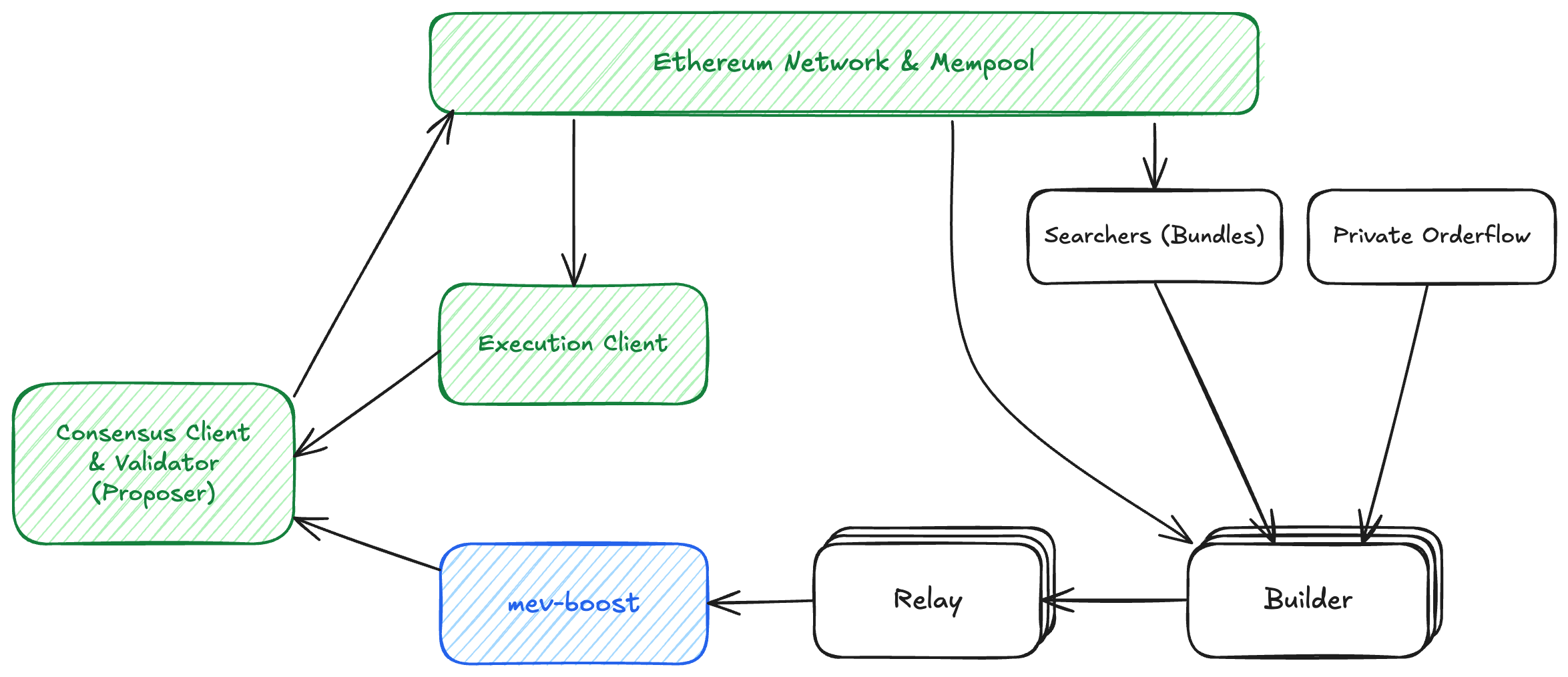
The builder-proposer interaction is organized out-of-protocol through trusted intermediaries, relays, that organize an open-bidding first-price auction with the default implementation of MEV-boost (there are also modifications of that auction including commit-boost). ePBS changes this architecture, by offering an in-protocol path for the builder-proposer exchange. Builders can become a staked entity in-protocol. The builder sends a signed commitment to a payload and a bid to the proposer. In case the proposer selects this bid, payments are enforced in-protocol by deducting it from the builder’s staked balance and paying it to the proposer’s withdrawal address. The builder is responsible for revealing and delivering the payload to the network. It only becomes canonical if it is seen by a particular deadline by the Payload-Timeliness Committee (PTC).
There are several ways for the proposer to communicate with builders in ePBS. While bid submission over the P2P-layer is supported, it seems likely that the preferred channel to bid in-protocol is for proposers to ping a list of builders who reply with a signed bid. This would effectively make the auction sealed, unless the proposer forwards these bids to other parties. The resulting system would look roughly like this:
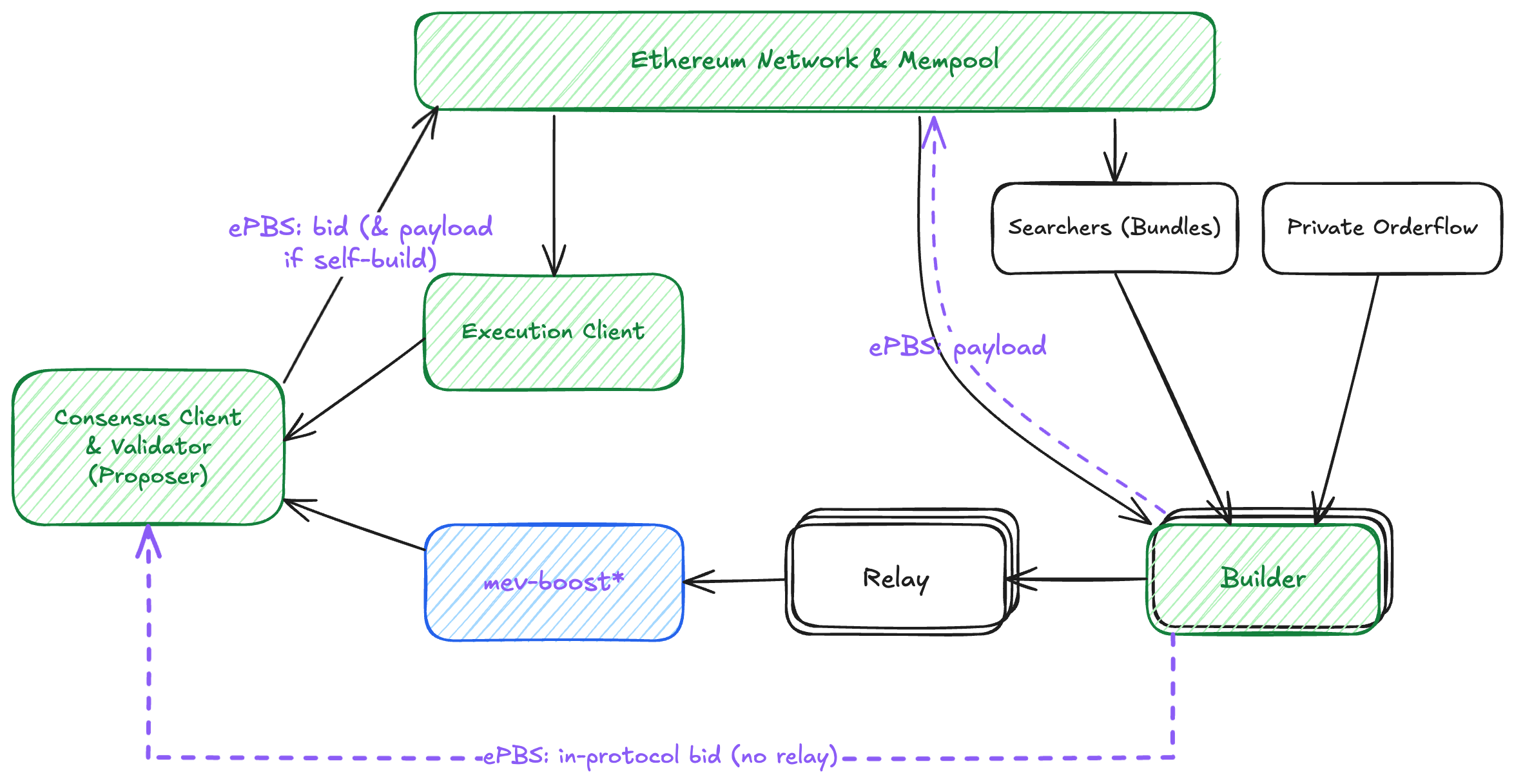
We leave the relay-path in the graph intentionally: It is of course hard to predict the future without risking to look silly later. Still we dare to predict that relays will remain to exist in some shape or form post Glamsterdam. There are several reasons:
- Un-collateralized or Under-collateralized bidding: even if builders can bid in protocol, they might (sometimes) prefer an out-of-protocol way of bidding to avoid maintaining large staked balances in-protocol or to register as a builder in-protocol altogether. Relays support un-collateralized bids (through simulating the payload) or under-collateralized bids (in their optimistic relaying path). This is attractive to builders that only build occasionally and for which staking balances to cover their bids for the rare case in which they are selected is wasteful. But it is also a generally useful feature to support large bids, for occasional high value blocks without staking large balances in-protocol.
- additional features: relays offer additional features that facilitate the life of builders. They can help with builder discovery, in case a builder is not known and thus not pinged for a bid by proposers. Moreover, they can help with fast payload distribution through the relay and relay-proxies.
- innovation and builder-relay convergence: the previous two items argued that some features that relays offer today will remain to be useful in an ePBS world. It seems entirely plausible, moreover, that relays will innovate beyond the status-quo to remain attractive in an ePBS world. For example, relays could offer block-merging features. A recent post of the blockspace forum describes the vision of a multi-party block production pipeline. These innovations may lead to convergence of the relay and builder role with a spectrum of architectures in-between being possible.
Even though we predict that relays will remain to exist in an ePBS world that doesn’t mean that a trustless payment channel in-protocol wouldn’t shape what relays can and can’t do going forward. The availability of an outside option (even if hardly used) can fundamentally change a market. We explore this in two dimensions:
- Pricing rule: given that the in-protocol channel is first-price by construction, can a competing relay enforce any other pricing rule among its bidders?
- Information sharing: can some form of open bidding survive? In particular, does the proposer have an incentive to forwards bids that they receive to other parties - builders or relays? Can the relay enforce open bidding among its bidders?
Trustless payments forces a first-price
It could be attractive for the relay to run a “second-price” feature where the relay forwards the second highest rather than the highest bid to the proposer as payment, as long as the SP outbids the best competing bid through an outside channel. An implementation of this feature in the current PBS world is Ultrasound’s bid adjustment. The in-protocol bidding channel of ePBS would compete with any such “second-price” relay. Furthermore, in contrast to the current PBS world with open bidding, the in-protocol path does not leak bids to the second-price relay, unless the proposer explicitly wants to leak these bids. Thus, the second-price relay does not know which price to beat from the first-price in-protocol channel. In the paper we show that this makes the second-price relay unravel completely: If the proposer does not forward their max bids to the second-price relay and keeps the in-protocol auction sealed, then bidders have an incentive to bid through the first-price channel in-protocol rather than through the second-price relay channel.
Theorem: If there are competing second-price and first-price (sealed-bid) bidding channels, then in any symmetric equilibrium the winning bid will almost surely be submitted through the first-price channel. This holds both in the single-homing case - the second-price relay can enforce that bidders that bid with them are not allowed tp bid through the other channel - and in the multi-homing (multi-plexing) case - bidders can submit bids to both bidding channels simultaneously. A second-price relay auction will unravel.
The multi-plexing case has additional subtleties: if a relay can’t enforce that bidders bid with them exclusively they might also not be able to enforce that bidders send multiple bids through different identities to them. That would allow bidders by themselves to turn the second-price into a first-price by e.g. submitting two matching bids. In the paper, we expand more on this, which probably is more of an interesting curiosity than a realistic concern. Instead we want to look at the more important dimension of bid sharing in the ePBS world.
Information sharing
How information about other bidders’ bids is shared publicly is an important determinant of auction outcomes. In our story of a relay bidding channel and an in-protocol trustless bidding channel there are two ways in which information can flow: the relay can make their received bids public or not. And the proposer can forward their in-protocol received bids to builders and/or the relay. The first (relay sharing bids) without the second (proposers sharing bids) has the natural tendency to unravel. This is the, basically trivial, observation that bidders like to know other bidders’ bids but want to keep their bid hidden. Thus, bidders have an incentive to listen to a public bid feed but to bid sealed themselves if possible. The question becomes more interesting, if the relay can impose single-homing on its bidders. In that case, we would expect a partial un-raveling of the relay auction: “fast” bidders that can re-act to other bidders quickly and thus have a “last look” may bid through the open relay auction while “slow” bidders opt into the sealed in-protocol auction.
A more interesting possibility is that the proposers share their bids with builders or the relay, thereby helping to maintain open bidding. The architecture would look roughly like this, where we can e.g. imagine that proposers run a mev-boost version as a side-car that forwards in-protocol bids to the relay or a side-car that forwards bids to their preferred builders:
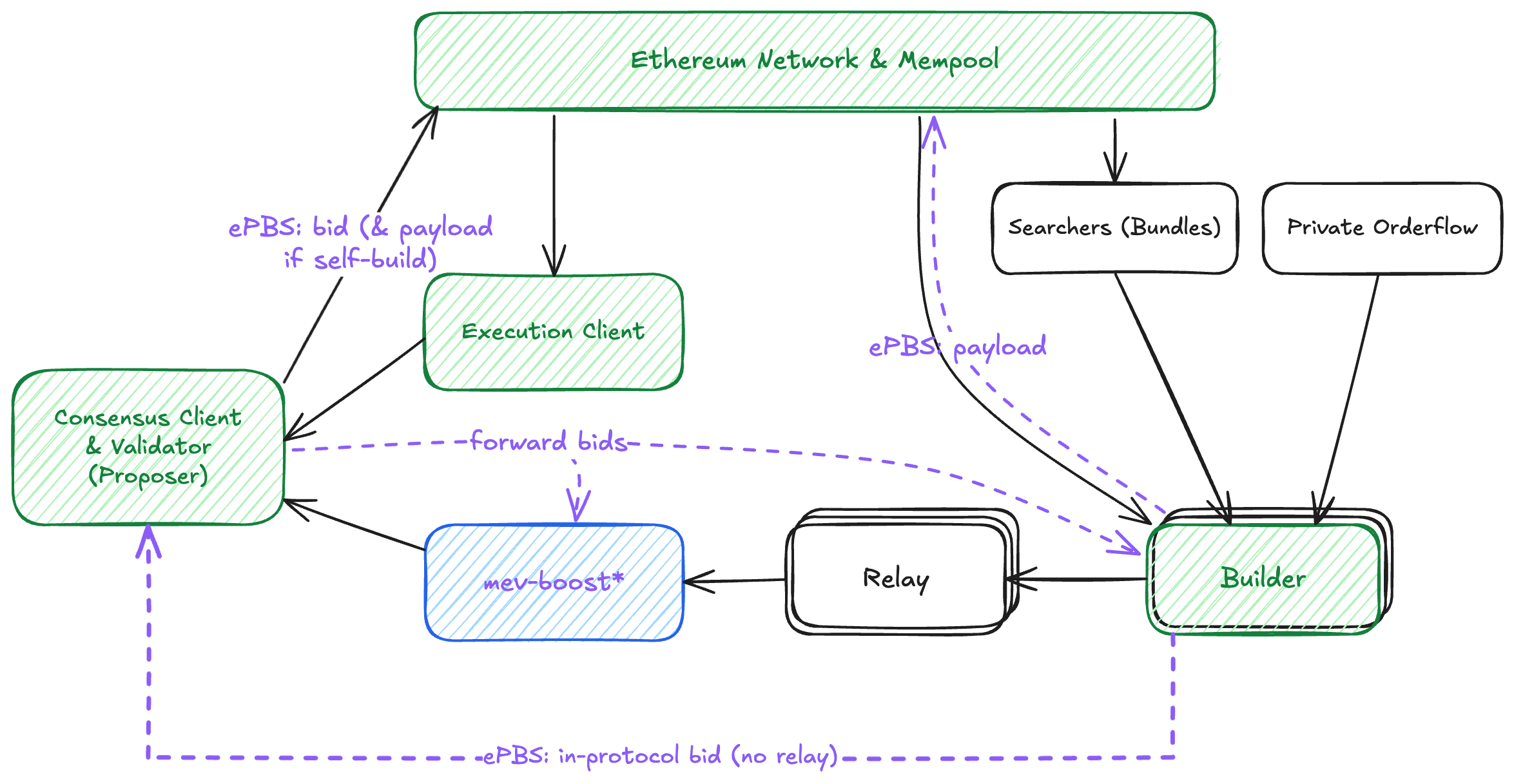
Can leaking bids be optimal for the proposer? We believe that this is best analyzed in a latency-aware model: in reality the exact bid deadline for the PBS auction is unknown and latency might determine whether a builder is still able to react to other builders’ bids in case they have access to them. In the paper, we analyze this in a model where a subset of “fast” bidders have a last look and react in case bids of “slow” bidders are shared with them. From the point-of-view of the proposer (and intermediaries such as relays) the relevant question is then whether sharing bids from “slow” bidders with “fast” bidders generates higher revenue in expectation.
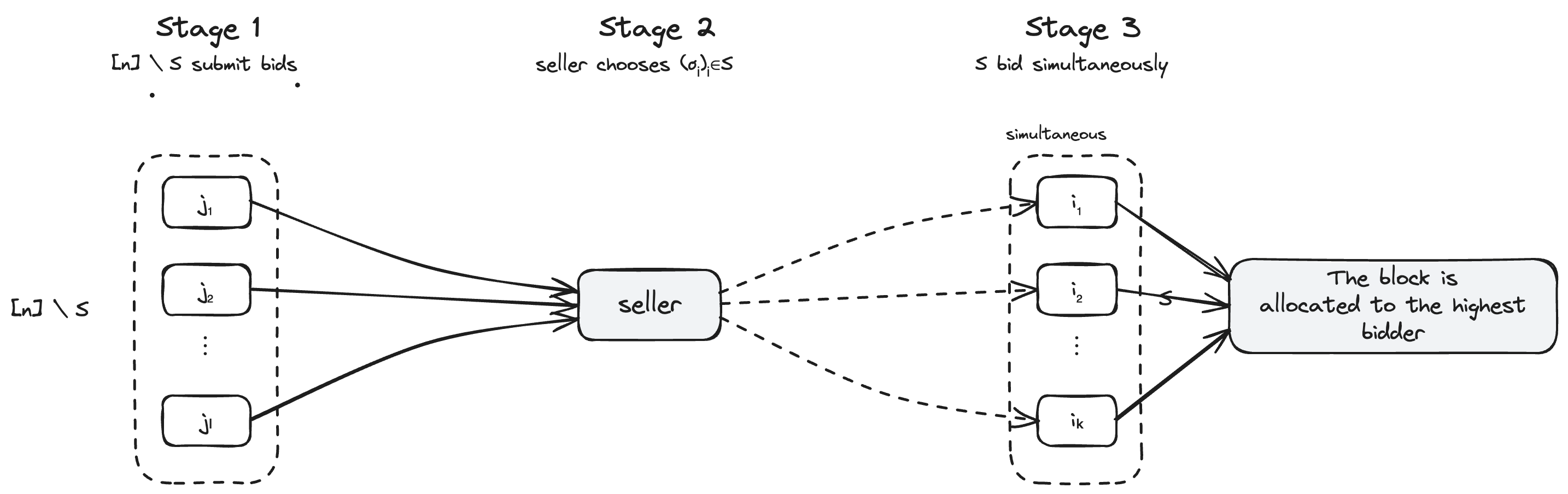
Theorem: In equilibrium, the proposer will not share bids with one “last look” bidder, but will share bids with multiple “last look” bidders, in case there are several competing fast (last-look) bidders.
In other words, in a world where there is just one latency-optimized fast builder, it is not optimal to share bids with that builder. Rather the proposer should keep bids sealed, since information rent can be captured through the fast bidder having to bid with uncertainty rather than “penny-ing” the highest bid among the competitors. Slow bidders have an incentive to send through the sealed-bid channel in that case. The sealed-bid channel is a desirable feature for them, as it would eliminate “penny-ing” in equilibrium. If there are several competing latency-optimized fast builders on the other hand, then, maybe more surprisingly, sharing bids with these builders is optimal for the proposer. The fact that there are multiple such builders guarantees sufficient competition among them while the “slow builder maximum” effectively functions as a “stochastic reserve price” that the proposer wants to disclose.
Credible Commitment
The situation changes fundamentally though, if the proposer can credibly commit ex-ante not to reveal bids to other parties. In the paper we show that commitment would guarantee the proposer higher revenue on average:
Theorem: The ex-ante expected revenue of a sealed-bid first-price auction is larger than the expected revenue of a first-price auction that gives last look to a subset of bidders (for any such subset).
In other words, a proposer who wants to maximize their staking income would want to commit to running a sealed-bid first-price auction if they could credibly commit to do so. This makes a difference, because committing to not-reveal, let’s builder bid more aggressively. The problem is that the commitment is not self-enforcing in equilibrium. Builders have no reason to believe that proposers have configured their node so that it does not leak information to fast bidders, unless there is a way of verifying that.
While credible commitment devices are not readily available for small solo stakers, the situation might be different for large institutional stakers (Coinbase) or staking pools (Lido). Credible commitment could be achieved for example through
- trusted execution environments (TEEs) when validator nodes are deployed in the cloud
- intermediation, e.g. a credible first-price sealed-bid relay
- (re)-staking mechanisms or
- pure reputation.
The latter two mechanism would require some probability of detecting informative leakage to guarantee credibility. If credible proposer commitments are achievable the resulting architecture would look roughly like this:
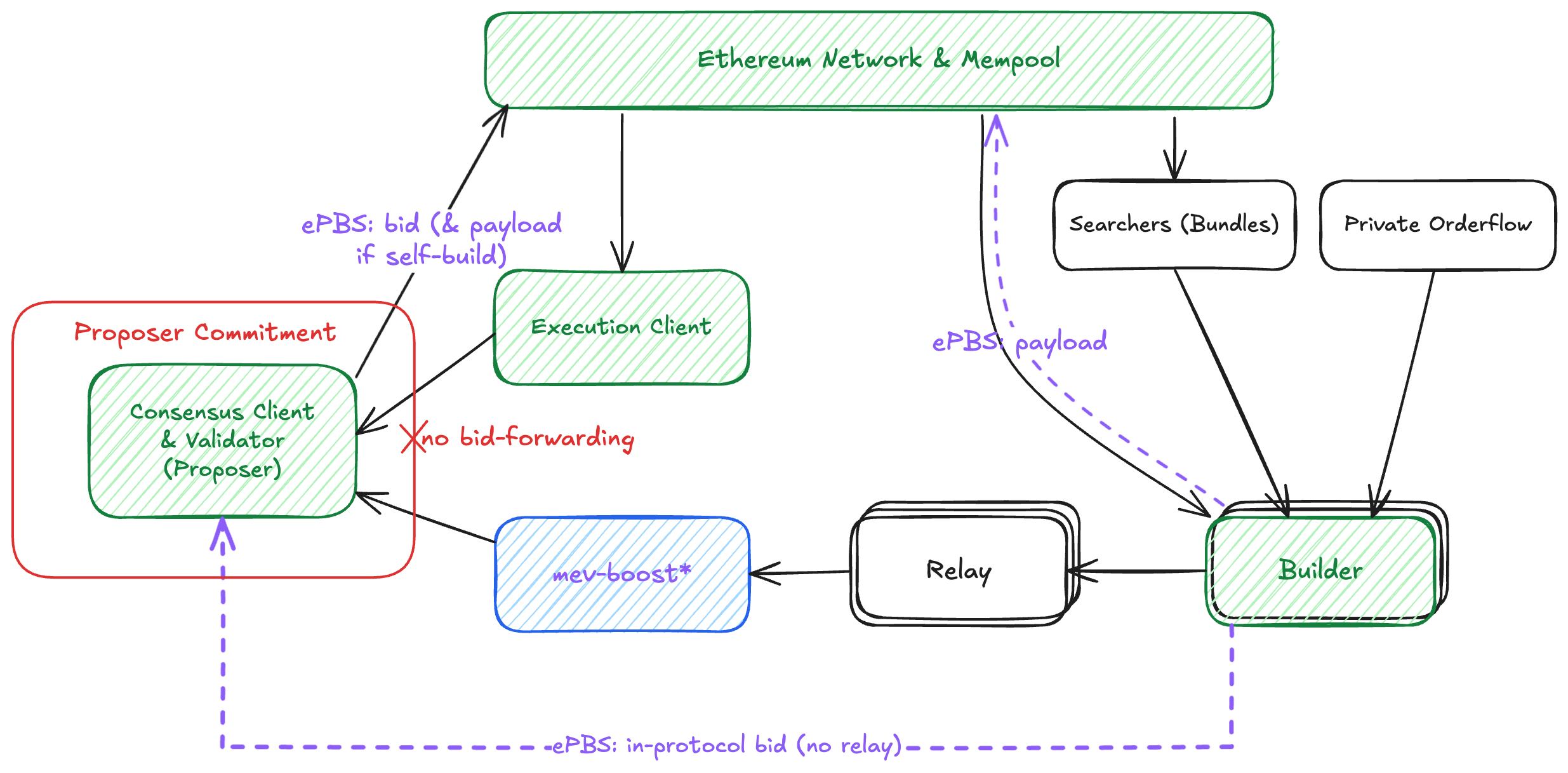
Credible commitments open of course much broader possibilities to proposers than just committing to not leak bids. For example, the proposer can commit to a reserve price in the auction. It is worth noting that we haven’t observed adaption of such commitment devices in the current PBS landscape.
Conclusion
The availability of the in-protocol bidding channel of ePBS likely will fundamentally constrain what relays can do and not do going forward. Competition between intermediation mechanisms shapes which mechanisms can be used. We predict that it is hard or impossible to maintain a second-price or bid-adjustment feature in the presence of a sealed-bid in-protocol bidding channel. The more subtle question turned out to be whether bidding remains (partially) open in an ePBS world: having a sealed bidding channel is attractive to take away some market power of a single dominant “fast” builder. However, if there are multiple competitive fast builders, the incentives flip and a proposer (likely through intermediation of a relay) wants to share received bids publicly. But if they could credibly commit ex-ante to not leak bids they would actually prefer that. Keeping the auction sealed gives more revenue in expectation to the proposer. These results hint both at possible products to be designed, as well as to an inherent fragility of the open bidding PBS auction. There is a narrow path to keep the PBS auction completely “open” post-Glamsterdam, e.g. by creating a side-car solution that forwards bids from the proposer to a relay or builders directly, thereby creating an open-bidding feed of all in- and out-of-protocol bids. However, the proposer incentives to opt into such a system are only intact under narrow circumstances.