Proof-of-Time: Completing the Timing Game
How PoT Shifts the V/c Equilibrium — With Numbers
OpenTTT Research Team — March 2026
A response to: Mazorra, Schlegel & Mamageishvil, “Timing Games: Probabilistic Backrunning and Spam” (arXiv:2602.22032)
by @BrunoMr, @Christoph, Akaki Mamageishvili
Building on: Proof-of-Time: From Trust-Based to Physics-Based Transaction Ordering
The Setup
Three months ago, Mazorra, Schlegel & Mamageishvil published a result that deserves to be read as a completeness theorem about the current state of blockchain ordering — not merely as an academic observation about MEV.
Their key finding: in the unique symmetric Nash equilibrium of the timing game, expected spam satisfies
E[S] = V/c − 1
where V is the value of winning the ordering race and c is the cost per attempt. This is not a description of irrational behavior. This is the correct output of a correctly functioning competitive market, given current cost structures. Rational agents should spam. The spam is not a bug. The spam is the equilibrium.
Mazorra et al. proved the problem is structural. They did not claim to solve it. They were right not to — the solution requires a different kind of intervention than the ones the MEV literature had been exploring.
We think we have that intervention. This post is about the numbers.
The Intervention: Raise c, Not Lower V
Most MEV mitigation approaches work on V — private mempools reduce the information advantage that makes front-running profitable, redistribution mechanisms spread the surplus, TEEs hide the transaction content. These are genuine improvements. None of them change the cost structure of the game.
PoT’s Adaptive Switch works on c.
When a builder submits a block that reorders transactions relative to their verified PoT timestamps, the AdaptiveSwitch classifies that builder as FULL MODE: ~127ms processing latency, standard fees, exponential backoff up to 320 blocks. An honest builder stays in TURBO MODE: ~50ms latency, 20% fee discount, no cooldown.
The latency delta is Δτ = 77ms.
This changes the effective cost of attempted reordering. Where c₀ is the baseline cost per attempt, the detected reorderer now faces:
c_PoT = c₀ + λ · Δτ
λ is the operator’s opportunity cost per millisecond — how much profit they forgo per ms of delayed throughput. Plug this into the Timing Games formula and the equilibrium shifts. There exists a threshold V* below which spam becomes irrational:
V = c₀ + λ · Δτ*
For V < V*: E[S] ≤ 0. The ordering race is not worth playing.
This is Theorem 4 in our Nature submission (Manuscript #2026-03-08858, currently under review). The proof follows directly from Mazorra et al.'s framework. We are not replacing their result. We are parameterizing it with a cost structure that didn’t exist before PoT.
The Numbers: What V* Actually Is
Until today, V* was a theoretical construct. We calibrated it.
Data source: 151,423 Timeboost express-lane auctions, Arbitrum, April–July 2025 (Messias & Torres, arXiv:2509.22143). Timeboost sells a 200ms ordering advantage per 60-second round. The winning bid equals the buyer’s expected MEV within that window.
λ derivation: λ = (clearing price per round) / 200ms
| Market phase | λ ($/ms) | V* (c₀ = $0.01) | Spam outcome |
|---|---|---|---|
| Stable (May+ 2025) | $0.11 | $8.67 | Eliminated |
| Central estimate | $0.16 | $12.57 | Eliminated |
| Competitive (Apr 2025) | $1.13 | $87.13 | Eliminated |
| — | — | — | — |
| ETH L1 sandwich avg (EigenPhi 2025) | — | $131 | Reduced |
Reading the table:
For any MEV opportunity worth less than $8.67 — which describes the vast majority of DeFi activity — PoT Full Mode makes the ordering race unprofitable at stable λ. The spam does not get managed. The spam does not get redistributed. The spam goes to zero, because the V/c ratio no longer supports it.
For the competitive April phase (λ = $1.13/ms), that threshold rises to $87.13. Still below the $131 average Ethereum L1 sandwich. But the $131 figure is a mean — it masks a distribution. A meaningful fraction of sandwiches are below $87. Those disappear entirely under competitive conditions.
The ETH L1 average sits above V*_max. For the highest-value attacks, PoT reduces but does not eliminate spam — consistent with Mazorra et al.'s framework. We are not claiming to solve the Coinbase-grade MEV problem. We are claiming to eliminate the noise floor.
As our working group noted during the design review: “The $131 number is the mean. The median sandwich is much smaller. PoT is not going to stop Jared — but it will stop the 80% of attempts that are not Jared.”
The Equilibrium, Visualized
Figure 4 — Equilibrium spam E[S] under PoT
Three curves, same formula E[S] = V/c − 1, different c. The green-shaded region (V < $8.67) is the elimination zone — spam goes to zero at stable market conditions. All numerical data reproducible: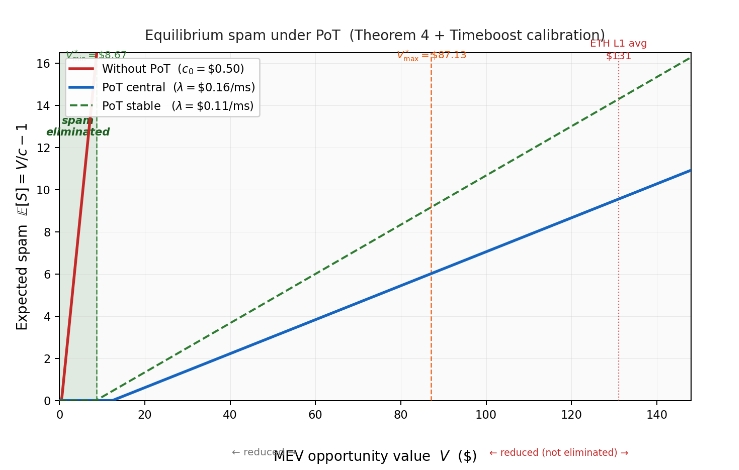
The important observation: the curve does not shift gradually. It shifts structurally. Any V below V* produces zero spam under PoT, regardless of how close V is to the threshold. This is the nature of Nash equilibria — the strategy is binary at the margin.
What This Means for the Timing Games Framework
Mazorra, Schlegel & Mamageishvil proved that the timing game has a unique symmetric Nash equilibrium and derived its structure. That result stands. PoT does not contradict it.
What PoT does is complete the framework by providing a mechanism that changes the equilibrium’s parameterization. Their paper proves the game has a stable equilibrium at V/c. Our paper shows that c is not fixed — it can be raised structurally via cryptographic verification costs. The equilibrium point moves. At sufficient c (i.e., sufficient λ), the equilibrium tips below zero spam for most observed V.
Put differently: Timing Games defined the equation. PoT provides a term that was missing from the cost side.
We hope the authors see this as a constructive extension of their framework rather than a challenge to it. The cleanest way to describe the relationship: their paper is the existence proof that the problem is structural; our paper is the construction proof that the cost structure can be changed.
The Structural Reason PoT Works Here
A note on why Δτ = 77ms is the right unit of intervention.
The AdaptiveSwitch penalty is not a fine. It is not a slashing condition. It is a latency cost applied at the throughput level. For a builder optimizing for MEV extraction, the opportunity cost of 77ms compounds with the frequency of detection. At modern block rates, a builder in Full Mode for 320 blocks is out of competitive position for meaningful periods.
More importantly: the penalty is cryptographically determined. No governance committee votes on who is in Full Mode. The PoT record is either valid or it isn’t. The builder who reorders either generated a valid timestamp before the reorder or didn’t. The enforcement is not social — it is mathematical.
This matters because the Timing Games equilibrium is sustained by the assumption that c is exogenous and fixed. PoT makes c endogenous — a function of how the builder behaves. An honest builder experiences c₀. A reordering builder experiences c₀ + λ·77ms. The cost discrimination is automatic and objective.
The Shannon Gap (Brief Version)
We are reserving the full theoretical treatment for peer review. But for context:
The reason this class of problem did not have a formal name until recently is that Claude Shannon’s framework — still the foundation of everything in information theory — assumes the channel is passive. Noise is stochastic. The channel operator has no preferences. Shannon modeled every form of random corruption but never the case where the channel controller is an economic agent who profits from strategic reordering.
MEV is the first large-scale instance of what we call the Strategic Channel Controller Problem (SCCP): the party controlling transmission order has financial incentive to misrepresent it. PoT is — to our knowledge — the first cryptographic primitive designed specifically for this case.
The full formalization, including the relationship to Shannon’s noisy channel theorem, is in the Nature manuscript. We are not publishing that here because it is under editorial review. What we will say: the Timing Games result and the SCCP definition are two descriptions of the same underlying problem — one in game-theoretic language, one in information-theoretic language. They give the same answer about what the solution requires: change c structurally, not V circumstantially.
The Finding That Surprised Us
When we look at our deployment data, over half of all PoT records were generated not by DEX traders but by AI agents via MCP calls.
We did not design for this. We did not anticipate it. It happened because AI agents communicating over HTTP generate and verify PoT proofs at sub-second intervals, faster than on-chain settlement latency. The ordering problem that Timing Games models for human traders is, it turns out, more acute for autonomous agents — not less.
Two human traders competing for a DEX slot have asymmetric reaction times and asymmetric information. Two AI agents competing for the same slot have symmetric reaction times and potentially symmetric information. The ordering race between agents is a purer version of the timing game, and the equilibrium spam under current infrastructure is correspondingly worse.
As AI agent economies scale — and they are already scaling, as the deployment data shows — the Timing Games result does not become less relevant. It becomes more relevant. The V/c equilibrium that applies to human MEV actors today applies to AI agent coordination tomorrow, at much higher frequency and much lower latency.
PoT’s value for AI agent economies is not MEV protection for humans. It is temporal authentication for autonomous systems — the cryptographic primitive that lets one agent prove to another that it submitted a transaction at a specific time, without a trusted third party.
This is a preview of a larger problem. We are publishing the observation here because it emerged from deployment and belongs in the community record.
Open Questions We Are Not Claiming to Have Solved
1. Cross-domain λ calibration. The numbers above come from Timeboost auction data — a specific L2 environment with specific builder economics. The V* framework generalizes to any environment where you can measure λ (the opportunity cost per ms of throughput delay). We have the methodology. We do not have the numbers for Ethereum L1, other L2s, or non-EVM chains. Those measurements require on-chain data from those environments.
2. The production gap. Base Sepolia deployment validates the mechanism. Mainnet deployment requires additional security review, particularly around ERC-1155 anchoring under sustained adversarial load. We do not claim mainnet equivalence from testnet data.
The Line
Mazorra, Schlegel & Mamageishvil proved the timing game has a stable equilibrium. They identified the equation. They showed why policy approaches (changing V) are insufficient.
PoT changes c.
Not through governance. Not through social contracts between builders who share interests. Through a cryptographic proof that makes dishonest ordering detectable, and a cost structure that makes it unprofitable. The equilibrium does not disappear — it moves to a regime where spam is irrational for the vast majority of observed opportunity values.
Extending V*: The Slashing Path
The table shows V*_max ≈ $87 at competitive λ. The ETH L1 average sandwich sits at $131 — above that threshold. For the highest-value attacks, PoT Full Mode reduces but does not eliminate spam.
There is a path to eliminating it entirely, and it follows from the same mathematics.
Theorem 3 establishes P(forge) ≤ 6·2⁻⁶⁴ — a GRG violation is not probabilistically detectable but mathematically self-identifying. A builder who reorders relative to a valid PoT record has produced a cryptographic proof of their own misconduct. That proof is as rigorous as any slashing condition in existing staking protocols.
The extension: require builders to post a stake, and slash it automatically on GRG violation. The slashing amount scales with V:
S(V) ≥ V − c₀ → E[profit from reordering] ≤ 0 for any V
At this point, V* ceases to be a threshold and becomes irrelevant — no V justifies the attack. The equilibrium collapses to zero spam across all opportunity values.
This is not speculative. The cryptographic foundation (P(forge) < 2⁻⁶¹) already exists. What it requires is a staking contract and slashing mechanism — infrastructure that exists in the Ethereum ecosystem and that PoT’s on-chain anchoring is structurally compatible with. We consider this the natural V2 path: AdaptiveSwitch as the latency-based V1, stake-and-slash as the capital-based V2.
The Timing Games framework predicts both. The cost c rises either through throughput penalties (V1) or through capital at risk (V2). The equilibrium responds to c regardless of its form.
The V* numbers are real. The deployment is live. The Timing Games framework predicts what PoT does. The data confirms it.
References and Resources
- Mazorra et al. Timing Games: Probabilistic Backrunning and Spam. arXiv:2602.22032 (2026)
- Messias J. & Torres, C.F. The Express Lane to Spam and Centralization: An Empirical Analysis of Arbitrum’s Timeboost. arXiv:2509.22143 (2025)
- EigenPhi Research. MEV Sandwich Attacks: Annual Loss Estimates. Public report (2025)
- Proof-of-Time: From Trust-Based to Physics-Based Transaction Ordering — Flashbots Collective (earlier post)
- IETF:
draft-helmprotocol-tttps-00 - EIP-8201 (active review, ethereum-magicians.org)
SDK: npm install openttt | GitHub: Helm-Protocol/OpenTTT