Geography is destiny.
Public blockchains like Ethereum were built to transcend borders. Yet if you plot where their validators actually run, the map tells a different story — dense clusters around the Atlantic, where the infrastructure is favorable and latency is low.

Geographical decentralization has clear benefits: it improves resilience, reduces correlated failures, and strengthens censorship resistance — see Phil’s post “Decentralized crypto needs you — to be a geographical decentralization maxi” [1] for a great discussion.
But it also comes with a cost — higher latency. Meanwhile, latency is not neutral. Lower latency brings higher rewards for validators, especially in timing-sensitive strategies like block propagation and proposer timing games. This means the natural incentives that drive profitability can quietly work against decentralization itself.
Our new paper, Designing Ethereum’s Geographical (De)Centralization Beyond the Atlantic, digs into this tension. It asks a deceptively simple question: How does protocol design itself decide where validators end up?
Method: Simulating Migration in a Latency-Aware World
To explore this trade-off — between decentralization and latency advantage — we use an agent-based model (ABM), a standard approach for studying systems where individual actors adapt to incentives. Each validator is modeled as an agent that decides where to locate based on expected rewards, network delay, and migration costs. To ensure realism, we calibrate latency values using real-world measurements from Google Cloud [2], which reflect the actual propagation delays validators would face in each slot.
Our simulation spans multiple global regions and compares two paradigms of block building:
- Single-Source Paradigm (SSP) : validator outsources block building and propagation to a single third-party — similar to MEV-Boost today: proposers get blocks from a relay.
- Multi-Source Paradigm (MSP) : validator aggregates information distributed across regions to build the block and propagate the block — similar to local building.
Simulation Setup
General Setup
Our simulation models a simplified Ethereum-like environment with 1,000 validators running for 10,000 slots. Each slot lasts 12 s, with an attestation deadline of 4 s. For every slot, one validator is randomly selected as the proposer, while the remaining validators act as attestors. A block is considered canonical only if it receives votes from at least 2/3 of all attestors. At the beginning of each slot, the proposer will migrate to a new region if the marginal benefit of moving exceeds the migration cost.
Validator Distribution
We consider two types of validator distributions – both referring to their geographical placement across the world, not to differences in their stake.
- Homogeneous distribution : validators are evenly spread across seven macro regions, following the regional boundaries defined by Google Cloud:
North America, Europe, Asia, Middle East, Oceania, South America, and Africa.
This setting represents an idealized world where validators are globally distributed. - Heterogeneous distribution : validators follow a distribution close to what we observe in the real Ethereum network. In this case, we randomly sample 1,000 validators using real-world measurement data [3], where the majority are concentrated in Europe and North America.
Information Source Distribution
We similarly vary the placement of information sources — the signals or relays from which proposers draw transactions or blocks.
- In the homogeneous case, information sources are uniformly distributed across the same seven macro regions.
- In the heterogeneous case, information sources are either placed in the regions with low latency — North America, Europe and Asia, or with high latency — Oceania, South America, and Africa.
This setup allows us to study how the co-location or misalignment between validators and information sources affects migration incentives.
What do the Simulations Reveal
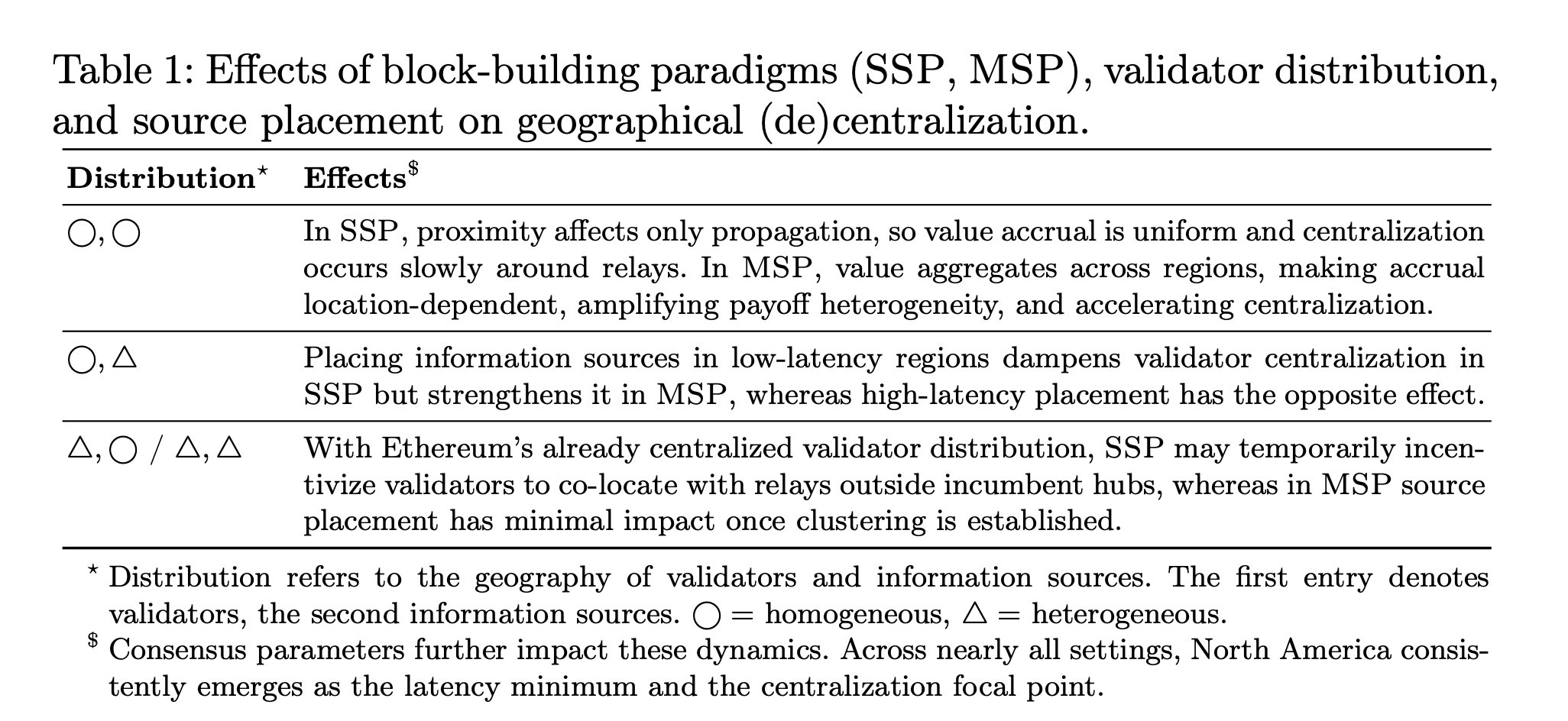
Our key takeaway suggests that SSP (i.e., PBS) can facilitate more symmetrical access to value across validators in different regions, provided that information sources, such as relays, are strategically placed. On the other hand, without PBS (i.e., MSP), where validators are responsible for aggregating value from multiple information sources, pressure to migrate to latency-optimized regions is stronger as value accrual is location-dependent.
We also observe that across nearly all settings, North America consistently emerges as the centralization focal point, as it offers the lowest average round-trip latency both to attesters and to information sources.
Alternative Ethereum Consensus Setups
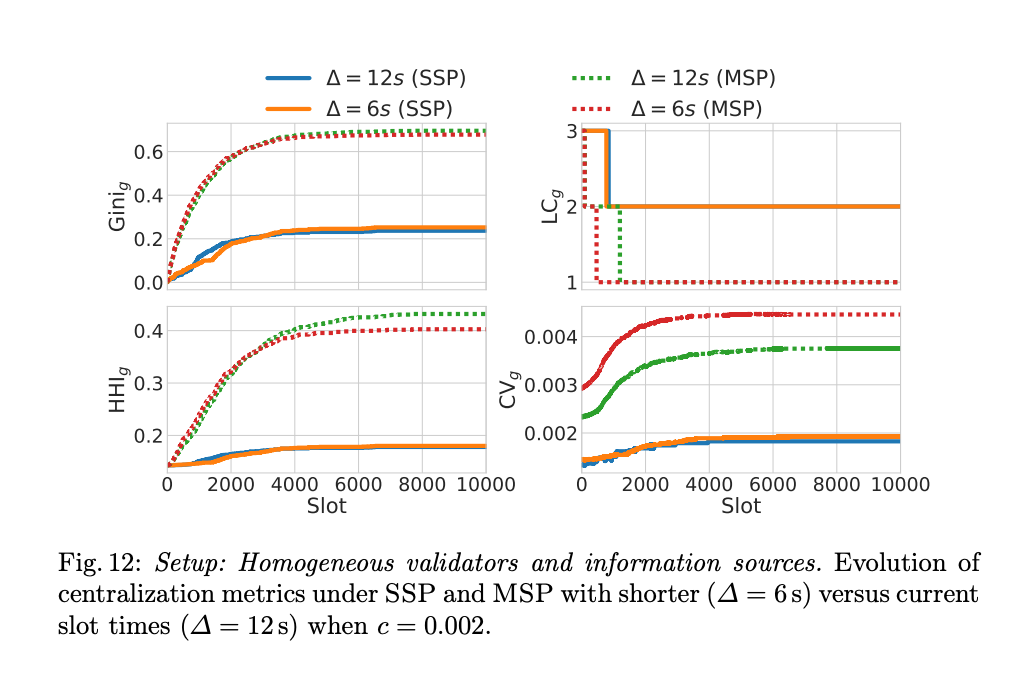
We also test alternative Ethereum consensus setups, such as EIP-7782 (6-second slot time). We find that because real-world propagation delays are small relative to the shortened slot, the centralization trajectories remain almost unchanged compared to today’s 12-second slot. However, the geographical payoff variation increases: shorter slots amplify reward dispersion, since the same latency edge occupies a larger share of the timing window and yields higher marginal gains.
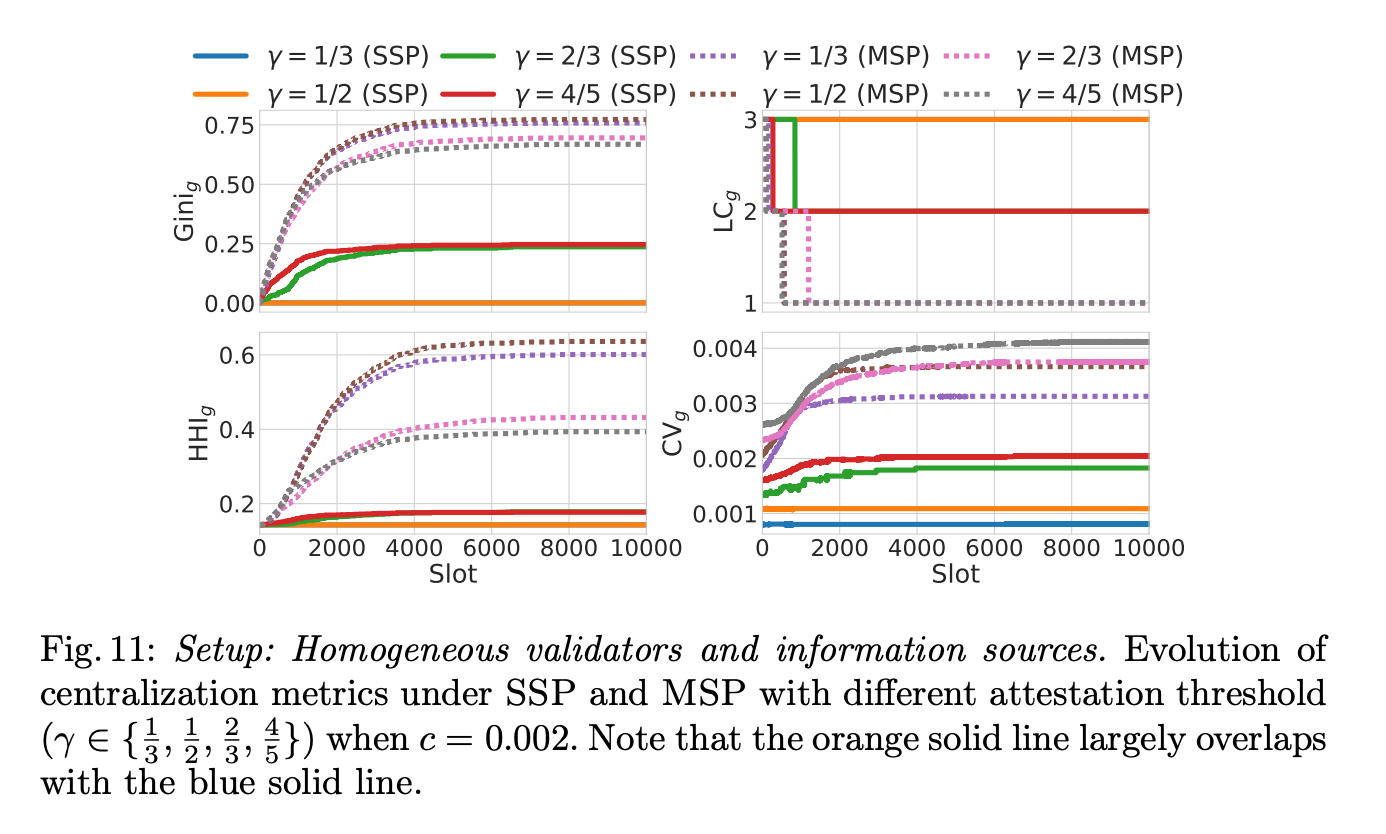
We next study how the attestation threshold — the quorum required for a block to become canonical — affects geographical centralization. Under SSP, higher thresholds tighten the effective timing window and amplify co-location incentives, leading to stronger centralization. Under MSP, however, the effect reverses: proposers must balance proximity to both attesters and information sources, which reduces the benefit of clustering around a single region.
Conclusions
Geographical decentralization is not a side concern — it is part of the system’s core security model. This study shows that design choices such as how blocks are built and information is propagated can strongly shape validator incentives, driving them toward or away from specific regions. As latency and value extraction continue to shape where validators prefer to locate, future protocol design must treat geography as a first-class parameter, not an afterthought.
This is joint work with Burak Öz, Fei Wu, and Fan Zhang, and most of the work was done during my internship at Flashbots. Beyond the paper, we’ve open-sourced our simulation framework and released an interactive visualization dashboard so others can experiment with new ideas and extensions. Together, let’s make blockchains more geographically decentralized!